Movement 7 min read
A Ladder of Small Movements
Free, simple ways to move at home that build on each other, rung by rung, for more energy and a longer, steadier life
Listen · 7 min
Download for later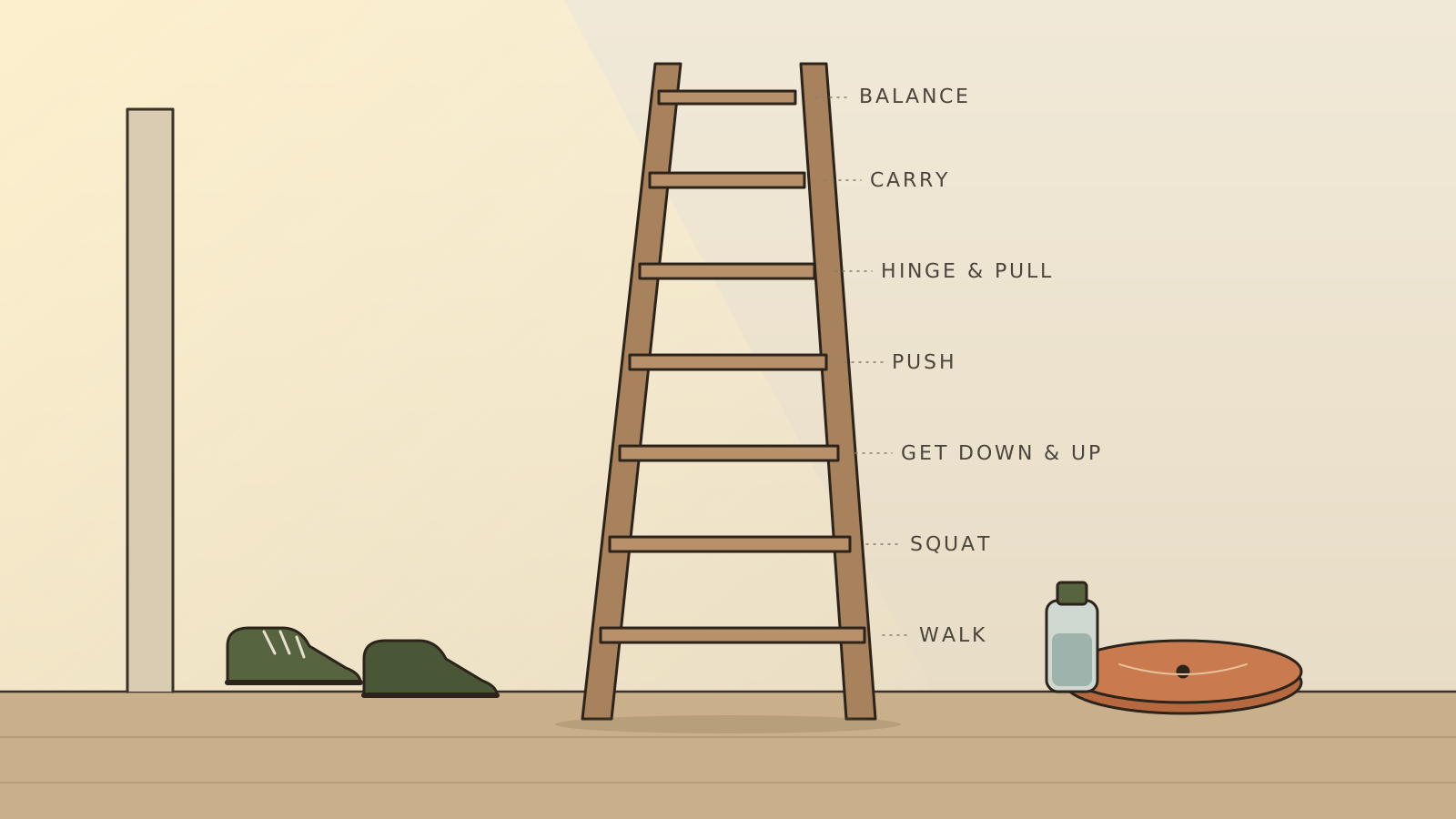
Watch a small child for an afternoon and you’ll see a full training programme, though nobody wrote it down. They squat to look at a beetle and stay there, heels flat, for a minute. They climb onto the sofa and roll off it. They carry things that are slightly too heavy, sit on the floor, get up again, run for no reason, and stop when they’re tired.
Somewhere between childhood and a desk job, most of us stop doing nearly all of that. Then, years later, we’re told we need to exercise: a word that suggests a special place, special clothes and a special hour that we never quite find.
There’s a simpler way back. It’s free, it happens mostly at home, and it treats movement the way this journal treats everything else: a few essential things, done well, built up slowly.
Two quiet tests the body keeps
Researchers looking for simple signs of long-term health keep finding them in very ordinary movements.
The first is the sitting-rising test. Stand barefoot, cross your ankles, lower yourself to sit on the floor, then stand back up, using as little help from your hands and knees as you can. A Brazilian team scored more than 2,000 adults aged 51 to 80 this way, out of ten, and followed them for about six years. People who could get down and up with little or no support lived markedly longer, and each extra point on the test went with about a fifth less risk of dying during the study.
The second is simply walking. When researchers pooled data from fifteen studies covering nearly 50,000 adults, the benefit of daily steps rose steadily and then levelled off: at around 6,000 to 8,000 steps a day for people over sixty, and 8,000 to 10,000 for younger adults. Not marathons. Just a life with a lot of walking in it.
Neither test proves that the movement itself adds the years; strong, mobile people may differ in other ways too. But the message is consistent, and it is encouraging: the abilities that matter most are humble ones, and they can be trained.
The goal isn’t fitness as a hobby. It’s keeping the ordinary abilities of a human body, for as long as you have one.
Movement snacks
The other encouraging finding is about how little it can take to start.
Using wrist-worn activity trackers from the UK Biobank, researchers studied more than 25,000 adults who said they did no exercise at all. Some of them, it turned out, still had short bursts of vigorous movement in their days: hurrying up the stairs, power-walking to the shops, chasing a child around the garden. Three or four of these one-minute bursts a day were linked with up to 40% lower risk of death over the following seven years.
Again, that’s an association, not a guarantee. But it changes the picture. Movement doesn’t have to be a separate event. It can be sprinkled through a day like salt:
- Take the stairs, briskly, every time.
- Walk fast for the last minute of any journey.
- Play properly with your children: be the one who chases.
- Carry the shopping home rather than wheeling it.
The ladder
Here is the heart of it. Almost everything a human body does is built from a few basic patterns, the same ones the child was doing on the living-room floor. Practise these, and everything else gets easier.
Each pattern below is a ladder. Start on the first rung. Stay there until it feels easy and steady, for weeks if needed, then step up. There’s no hurry. Each rung is built on the one beneath it.
Walk
- A daily walk, any pace, ideally outside.
- Longer walks, with a few minutes of brisk walking in the middle.
- Hills, stairs, uneven paths; a weekly long walk of an hour or more.
Squat
- Sit down onto a chair and stand up again without using your hands. Slowly.
- The same, without the chair: a full bodyweight squat, as deep as feels comfortable.
- Rest in a deep squat for a minute or two at a time, heels down if you can, holding a door frame for balance.
Get down and up
- Sit on the floor each day for a while: reading, playing, stretching.
- Practise getting down and up in different ways, using your hands less over time.
- The sitting-rising test itself, as a gentle daily habit.
Push
- Push-ups against a wall.
- Push-ups against the kitchen counter or a sturdy table.
- Push-ups on the floor, on knees first, then on toes.
Hinge and pull
- Bend from the hips to pick things up, back long, as if bowing.
- Rows: hold the edges of a sturdy door frame and lean back, then pull yourself upright.
- Lift a heavy backpack or bag of books from the floor with a long back, and row it towards your chest.
Carry
- Carry the shopping home, one bag in each hand, standing tall.
- Carry something heavy (water bottles, a full bag, a child) for a minute at a time.
- Carry it uphill, or up the stairs.
Balance
- Stand on one leg while the kettle boils.
- Do it with your eyes closed, holding the counter if needed.
- Walk slowly heel-to-toe along a line on the floor.
Notice the shape of this. Nothing requires equipment you don’t own. Every rung prepares you for the next. And the movements combine: a carry up the stairs is walking, hinging, carrying and balance all at once.
A simple week
The UK’s Chief Medical Officers recommend that adults get around 150 minutes of moderate activity a week (or 75 of vigorous), and do something to strengthen the muscles on at least two days. Spread through a low-tech life, that can look like this:
- Every day: a walk, ideally in daylight; some time sitting on the floor; three or four movement snacks.
- Two or three days a week: twenty minutes at home, going through the ladders above at whatever rung you’re on. Two or three rounds, unhurried, with rests.
- Once a week: something longer and joyful: a family hike, a swim, a bike ride, a game in the park.
That’s it. No app needed. If you want to track anything, a pencil mark on the calendar works perfectly well.
Architecture, again
The same trick that keeps the phone at the end of the lane works here, in reverse. Make movement closer and easier than not moving.
- Leave walking shoes by the door, where the car keys used to be.
- Keep a floor cushion where the armchair is, so sitting on the floor is the obvious choice.
- Walk to the shop that’s twenty minutes away instead of driving to the one that’s five.
- Put the day’s movement next to something you already do: squats while the kettle boils, a walk after dinner, balance while brushing your teeth.
And it closes a circle with everything else here. Real food gives the steady energy; movement spends it well and makes more. Four thousand weeks is not a long time, but a body that can still sit on the floor with its grandchildren, and get up again, has more good weeks in it.
The child on the living-room floor isn’t exercising. They’re just living in a body, all the way. The ladder is simply a way back to that, one small rung at a time.
A note: this is general guidance for healthy adults, not medical advice. If you have a health condition, an injury, or haven’t been active for a long time, check with your GP before stepping up the ladder, and let pain be your signal to stop.
Sources
- Brito, Araújo et al., sitting-rising test and all-cause mortality (European Journal of Preventive Cardiology, 2012), via the European Society of Cardiology
- Paluch et al., Daily steps and all-cause mortality: a meta-analysis of 15 international cohorts (Lancet Public Health, 2022)
- Stamatakis et al., vigorous intermittent lifestyle physical activity (Nature Medicine, 2022), via the University of Sydney
- UK Chief Medical Officers’ Physical Activity Guidelines (2019)