Living Well 14 min read
Cold Start
On the long distance between wanting and doing, why the fire comes after the first step and not before, and the quiet urgency of beginning today
Listen · 14 min
Download for later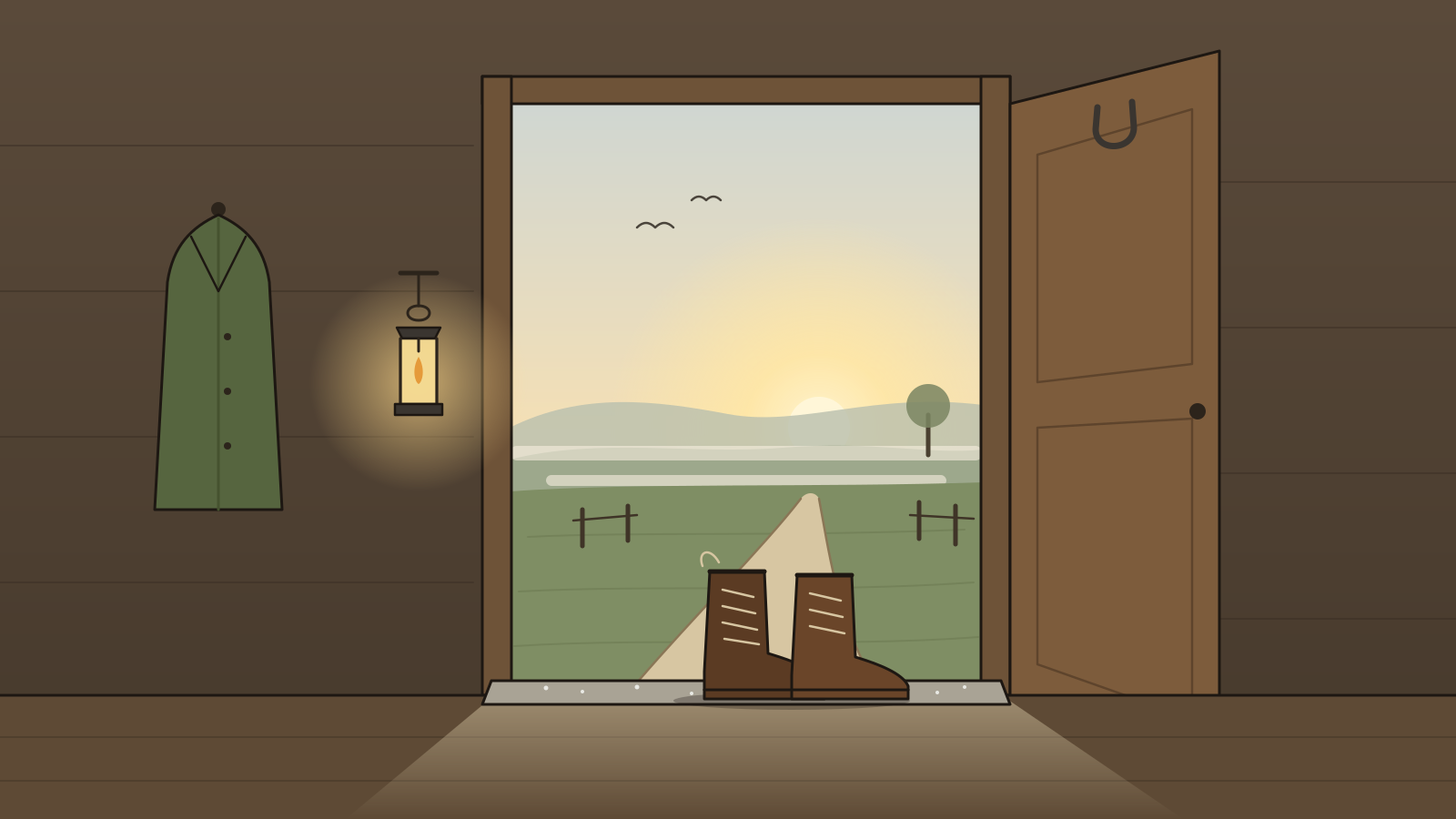
Anyone who grew up near a farm knows the sound of an old diesel engine on a January morning. You turn the key and nothing wants to happen. The oil is thick, the metal is cold, the starter groans. You wait for the glow plugs, you try again, it coughs, catches, dies. You try once more.
And then it runs. Rough at first, smoking, unhappy. Ten minutes later it purrs, and it will happily work all day.
Engineers call this a cold start. Almost all the difficulty of running an engine is concentrated in the first few seconds. Once it’s turning, it wants to keep turning.
People are made the same way. Nearly everything hard about changing a life is concentrated in the first few minutes of each attempt: the moment between sitting and standing, between the warm house and the cold step, between thinking about it and doing it. That moment is small. It is also where most good intentions go to die.
This piece is about that moment.
The quiet things in the corner
Look around almost any home and you’ll find them. The guitar that leans in the corner, still slightly out of tune. Running shoes with clean soles. A book that’s a third written, a language course on lesson four, a set of weights under the bed, a notebook with three pages filled and a date at the top of each one.
None of these is a failure, exactly. Each was bought by someone who sincerely meant it. Each is a small monument to a man he wanted to be.
The researchers have names for this. Psychologists call it the intention–behaviour gap. When Ryan Rhodes and Gert-Jan de Bruijn pooled studies of people who had intended to be physically active, they found that nearly half of them, 46%, didn’t follow through. Not lazy people. People who had said, sincerely, yes, I’m going to do this.
Two economists, Stefano DellaVigna and Ulrike Malmendier, found the same gap in a set of American gyms. Members who chose a flat monthly fee of over $70 went, on average, 4.3 times a month: more than $17 a visit, when a ten-visit pass would have cost them $10 a visit. The title of their paper says it all: Paying Not to Go to the Gym. We don’t pay for what we do. We pay for who we intend to be, and then hope the payment will do the rest.
If you recognise yourself anywhere in this, good. It means you’re human, and it means you’re in excellent company. It also means that the gap isn’t a character flaw. It’s a pattern, and patterns can be understood.
Waiting for a signal that never comes
In Unix, a program can be in one of a few states. It can be running, doing work. Or it can be sleeping: blocked, waiting for something to happen before it continues. A program that reads from a pipe will sit and wait until something is written into the other end. If nothing is ever written, it waits forever. Patiently, politely, using no energy at all. Achieving nothing.
That is what waiting for motivation is like. We sit at the door of our own lives, blocked on a read, waiting for a feeling to arrive: the surge, the clarity, the sense that today is the day. We think the feeling comes first and the action follows.
It’s the other way round.
Motivation is mostly output, not input. It’s what doing something produces. You’ve felt this yourself: the walk you didn’t want to take, and how different you felt twenty minutes in. The job you dreaded, and the odd satisfaction once your hands were busy. Therapists who treat low mood use exactly this principle, called behavioural activation: you don’t wait to feel better before you act; you act, gently and in small ways, and the feeling slowly follows.
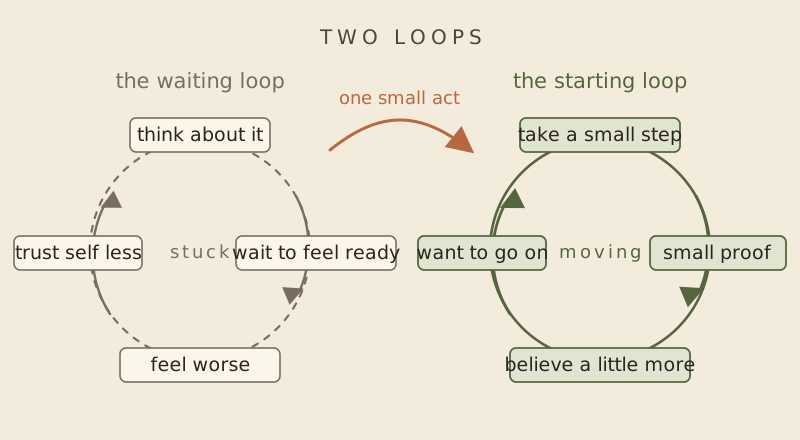
Both loops are self-reinforcing. That’s the frightening part and the hopeful part. The waiting loop feeds itself: each day you don’t begin, you trust yourself a little less, which makes beginning feel heavier tomorrow. But the starting loop feeds itself too. Each small act is a piece of evidence. Enough evidence and you start to believe a new thing about yourself.
Thinking is not a small version of doing
Here is something uncomfortable. Thinking about it, planning it, reading about it, buying the kit, watching the videos: these feel like progress. They light up the same hopes. They are not progress.
The psychologist Gabriele Oettingen spent years studying what she calls positive fantasies: vivid daydreams of the goal already achieved. Common sense says these should motivate us. Her studies found the opposite. In one, people who fantasised positively about the coming week reported less energy and, a week later, had got fewer of their goals done than people who had simply let their minds wander. In others, she and Heather Kappes measured blood pressure, a rough sign of the body getting ready to act, and found that it dropped during positive fantasies. The mind tastes the reward early, and the body quietly decides the work is already done.
So if you’ve been thinking about something for months, and feel more tired of it than ever, that isn’t a mystery. You’ve been paying for the meal without eating it.
There is a way to dream that helps. Oettingen calls it mental contrasting: picture the good outcome, and then, straight away, picture the real obstacle in your way. Not the outcome alone. The outcome, and the exact thing at the door that stops you. That pairing wakes the body up rather than putting it to sleep. We’ll use it in a moment.
Why we really don’t start
If it isn’t laziness and it isn’t lack of desire, what is it?
Tim Pychyl, who has studied procrastination for decades, puts it simply: it’s not a time-management problem, it’s a mood-management problem. With Fuschia Sirois he describes procrastination as giving priority to feeling better now over being better later. The task carries a small cloud of unpleasant feeling: effort, boredom, uncertainty, the fear of doing it badly. Putting it off makes the cloud lift, instantly. That relief is the reward. And whatever is rewarded is repeated.
For men in particular, there’s often another layer. Somewhere along the way many of us learned that a man should be able to simply do things: grit his teeth and get on with it. So when we don’t, we don’t just feel a delay. We feel a verdict. What’s wrong with me? I used to be someone who did things. That shame is heavy, and it makes the next attempt heavier still.
Here’s the surprising finding. Michael Wohl, Tim Pychyl and Shannon Bennett followed 134 first-year university students through two rounds of exams. Those who forgave themselves for procrastinating before the first exams procrastinated less before the second, and did better in them. Self-forgiveness wasn’t letting themselves off the hook. It was taking the weight off the hook, so they could lift it again.
So, before anything else:
Whatever you’ve been putting off, for however long, put the guilt down first. It isn’t helping you carry anything. It’s just one more thing to carry.
The urgency, gently
Now the other side. Forgiveness is not the same as forever.
Nearly two thousand years ago, a tired man in an army tent on the Danube wrote a note to himself. He was the emperor of Rome, and he was also, by his own account, a man who struggled to get out of bed in the morning. The note survives in his Meditations:
Remember how long thou hast been putting off these things, and how often thou hast received an opportunity from the gods, and yet dost not use it… a limit of time is fixed for thee, which if thou dost not use for clearing away the clouds from thy mind, it will go and thou wilt go, and it will never return.
Seneca put it even more simply in the first of his letters: while we are postponing, life speeds by.
In Four Thousand Weeks at the Kitchen Table, we did the arithmetic: a long life is about four thousand weeks. A season of waiting costs about thirteen of them. A year costs fifty-two. They don’t come back, and nobody sends an invoice. They simply go, quietly, the way an evening goes.
The psychologists Thomas Gilovich and Victoria Medvec asked people about their regrets. Over the short term, people tended to regret things they had done: the clumsy word, the bad decision. But when they looked back over their whole lives, the picture changed completely. In one of their studies, asked about the past week, people were split roughly evenly. Asked about their lives, 84% said their greatest regret was something they had not done.
The things you did badly fade. The things you never began stay. They grow, if anything, the longer you leave them.
And one more thing, for any man with children, or nephews, or younger men at work who watch him. They are not learning from what you say about effort, discipline and keeping promises. They’re learning from what you do on an ordinary Tuesday evening. Whether the boots by the door get worn. You are always teaching. The only question is what.
That’s the urgency. Not panic, not a deadline. Just the clear knowledge that this is your one life, it’s happening now, and the version of you who begins is waiting on the other side of a very small step.
Start small, the Unix way
There’s an old rule of systems design called Gall’s law, after John Gall, who wrote it down in 1975: a complex system that works is invariably found to have evolved from a simple system that worked. You can’t build the finished thing in one go. You build the smallest thing that works, then grow it.
It’s the same idea as Do One Thing Well: small tools, each doing one job, joined together. And it’s the same idea as A Ladder of Small Movements: start on the bottom rung, and stay there until it feels easy.
So, applied to the cold start, here is a small toolkit. Each tool does one thing.
1. Make the first step absurdly small
Not go for a run: put on your running shoes and step outside the front door. Not write the book: open the file and write one sentence. The aim isn’t the work. The aim is to cross the threshold, because the threshold is where all the resistance lives. Once you’re through it, you’ll very often keep going. And if you don’t, you’ve still kept the promise, and that is the real point.
2. Decide once, not every day
Every time you have to decide whether to do something, you give the tired, comfortable part of you a vote. Take the vote away. Write a simple if–then sentence, with a time and a place:
When I put the children to bed on Monday, Wednesday and Friday, I will put on my shoes and leave the house.
Psychologists call these implementation intentions, and they are one of the most reliable tools in the whole field. In one classic British study, Sarah Milne, Sheina Orbell and Paschal Sheeran asked young adults to exercise. About 38% of an ordinary group did so in the following week, and about 35% of a group given an inspiring talk on the benefits. In the third group, who also wrote down exactly when and where they would exercise, 91% did. The talk changed what people intended. The one written sentence changed what they did.
3. Name the dragon at the door
This is Oettingen’s mental contrasting, in plain clothes. Write down what you want, in a few words. Then the best thing about having it. Then the real obstacle: not the weather or your schedule, but the inner one. I feel tired after work and tell myself I’ll go tomorrow. Then the plan: if I feel tired after work, I’ll go anyway, for ten minutes only.
She calls it WOOP: wish, outcome, obstacle, plan. It takes five minutes and a piece of paper.
4. Put it where you’ll trip over it
Make the good thing easy and the default. The bag packed the night before and left by the door. The guitar out of its case, on a stand, in the room where you sit. The notebook open on the table. Friction decides more of our lives than willpower does. Spend your effort arranging the room once, not fighting yourself every day.
5. Don’t wait for Monday
Researchers at Wharton found something they call the fresh start effect: gym visits rise at the start of a new week, a new month, a new term, after a birthday. People love a clean line to start from. It’s a real and useful effect. But it has a shadow: I’ll start on Monday becomes I’ll start next month, and the clean line keeps moving away from you like a horizon.
Every day is the start of something: the rest of this week, the rest of this year, the rest of your life. Today will do.
6. Never miss twice
When Phillippa Lally and her colleagues at University College London followed 96 people building new daily habits, it took an average of 66 days for a habit to feel automatic, with a huge range, from 18 to 254 days. And, importantly, missing a single day didn’t make any real difference to the outcome.
So missing once is just life. Missing twice is the start of a new habit, the wrong one. The rule is simple: if you miss, the next time is non-negotiable, even if it’s only the smallest version.
7. Keep a tally, not a judgement
A pencil and a card on the fridge. A mark for every time you showed up. Not how well, not how long. Just showed up. Over weeks, the marks become something better than motivation: evidence. You stop hoping you’re someone who does this. You can count it.
A small man page
For those of us who think in terminals, here is the whole method in one screen.
NAME
    begin - start the thing you keep meaning to start

SYNOPSIS
    begin [today] [smallest-step]

DESCRIPTION
    Does not wait for motivation. Motivation is written
    to stdout after begin has been running for a while.

    Takes one small step. Exits successfully on any
    attempt, however short.

OPTIONS
    --forgive    discard all guilt from previous runs
    --again      run again next time; never skip twice

BUGS
    Thinking about begin is not the same as running it.

SEE ALSO
    ladder(1), enough(7), the-last-evening(1)
The step
Somewhere in your life there’s a door, and a pair of boots, or a guitar, or a blank page, or a phone call you’ve been meaning to make for months. You know what it is. You probably knew before you started reading.
You don’t need to feel ready. Nobody feels ready. The engine is always cold first thing in the morning. That’s not a sign that something is wrong; it’s simply how engines work, and how men work too.
So don’t make a plan for the whole mountain. Don’t wait for Monday. Forgive yourself for every day you didn’t, and then let those days go, because they’re gone anyway.
Then do the smallest possible thing. Today. Put the boots on. Open the door. Step out onto the cold stone and feel the morning on your face.
Turn the key. It will cough. It will catch.
And then it runs.
Sources
- Ryan Rhodes and Gert-Jan de Bruijn, How big is the physical activity intention–behaviour gap?, British Journal of Health Psychology (2013)
- Stefano DellaVigna and Ulrike Malmendier, Paying Not to Go to the Gym, American Economic Review (2006)
- Heather Kappes and Gabriele Oettingen, Positive fantasies about idealized futures sap energy (2011), summarised by the BPS Research Digest; on WOOP, Hidden Brain
- Fuschia Sirois and Timothy Pychyl, Procrastination and the priority of short-term mood regulation, Social and Personality Psychology Compass (2013)
- Michael Wohl, Timothy Pychyl and Shannon Bennett (2010), summarised by the BPS Research Digest
- Marcus Aurelius, Meditations 2.4, trans. George Long, at Lexundria
- Seneca, Moral Letters to Lucilius, Letter 1 (trans. Richard Gummere, 1917)
- Thomas Gilovich and Victoria Medvec, The temporal pattern to the experience of regret, Journal of Personality and Social Psychology (1994)
- John Gall, Systemantics (1975)
- Sarah Milne, Sheina Orbell and Paschal Sheeran, Combining motivational and volitional interventions to promote exercise participation, British Journal of Health Psychology (2002)
- Hengchen Dai, Katherine Milkman and Jason Riis, The fresh start effect, via Knowledge at Wharton (2014)
- Phillippa Lally and colleagues, How are habits formed (2010), summarised by James Clear