Living Well 12 min read
The Last Evening
On living a life that matters — noticing small joys, putting down what you were never meant to carry, thinking like a curious outsider, and arriving at the end able to say: it was well worth it
Listen · 12 min
Download for later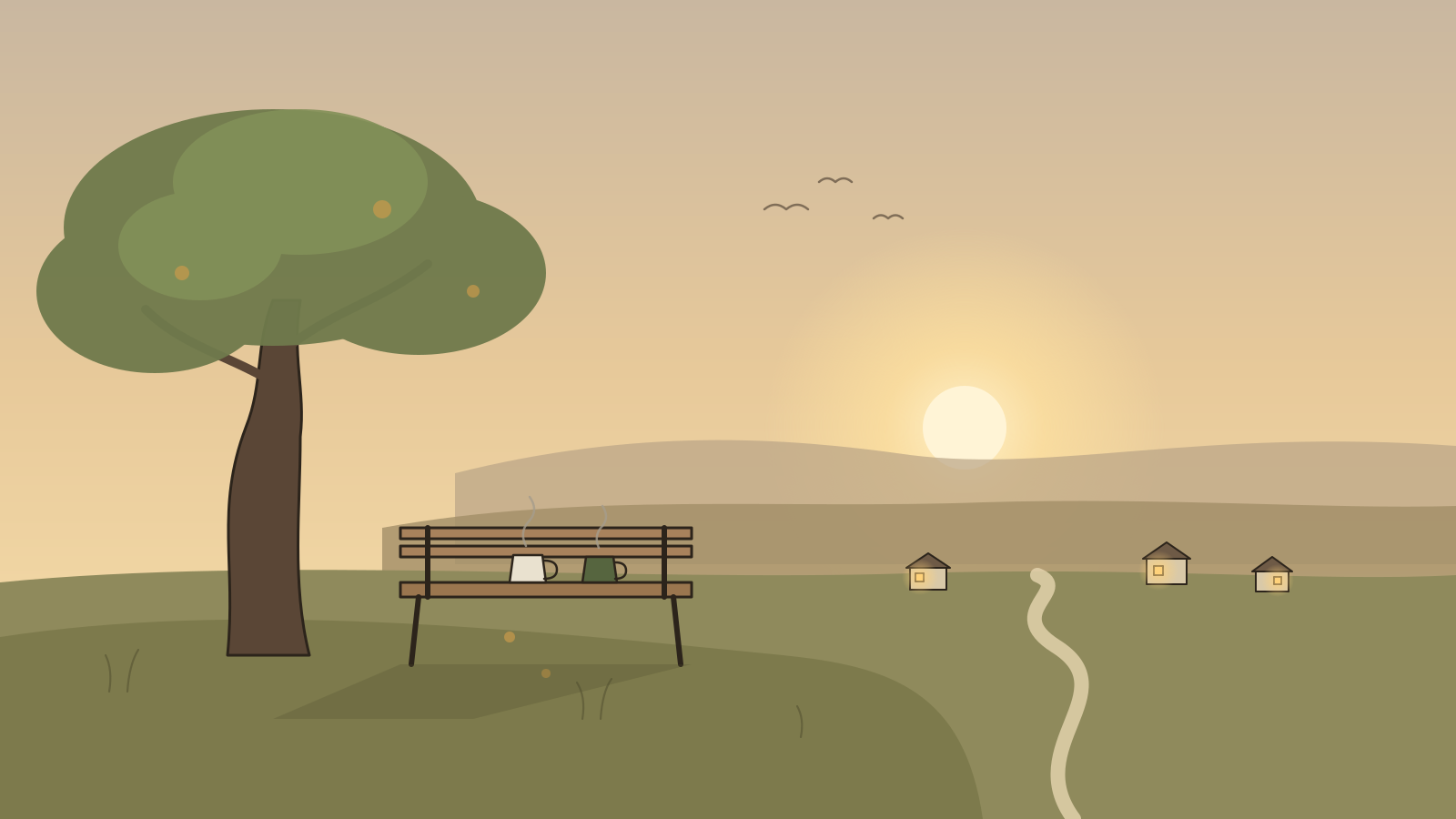
In 1886, Leo Tolstoy published a short novel about a man named Ivan Ilyich. Ivan does everything right. He studies, he works hard, he rises steadily through the courts, he marries suitably, he furnishes a fine apartment exactly the way successful people furnish apartments. Then, in his forties, he falls ill, and as he lies dying a terrible question arrives one night and will not leave:
What if my whole life has been wrong?
Not wicked. Just wrong: spent on the things that looked like life from the outside, while the real thing — a few moments of honest affection, a servant’s simple kindness, the joy he felt as a child — slipped past almost unnoticed.
It’s one of the most frightening stories ever written, and one of the most useful. Because it hands us a question we can ask while there’s still time to change the answer.
So try this, just for a moment. Picture the last evening of a long life — yours. You’re sitting somewhere quiet. A bench, perhaps, at the end of a garden, the light going gold. You’re looking back over the whole of it. What would have to be true for you to smile, and say, simply: it was well worth it. I lived it beautifully.
What the end makes clear
We know more about that evening than you might think, because people have told us.
Bronnie Ware spent years caring for people in the last weeks of their lives, and later wrote down the regrets she heard again and again. Her list became famous because it’s so plain:
- I wish I’d had the courage to live a life true to myself, not the life others expected of me.
- I wish I didn’t work so hard.
- I wish I’d had the courage to express my feelings.
- I wish I had stayed in touch with my friends.
- I wish that I had let myself be happier.
It’s one person’s observation, not a scientific study. But science has spent a very long time arriving at much the same place.
In 1938, researchers at Harvard began following 724 young men — some Harvard students, some boys from Boston’s poorest neighbourhoods — and they never stopped. The study now includes their children too, more than eighty-five years later, making it one of the longest studies of human life ever run. Its current director, Robert Waldinger, sums up the clearest finding in one sentence: the people who were most satisfied in their relationships at fifty were the healthiest and happiest at eighty. Better predictors, in fact, than their cholesterol. Loneliness, the researchers found, can be about as harmful to the body as smoking.
Not money, fame or achievement. Relationships. Warm ones, chosen and tended.
Notice that not one of the five regrets is I wish I’d owned more, or I wish I’d been more impressive. They’re all about courage, honesty, people and joy: things that were available all along, every single day, mostly for free.
The small things are the big things
Here’s the strange part. The joys that matter most at the end are usually small enough to miss in the middle.
The first sip of tea on a cold morning. A child’s hand finding yours without looking. Bread out of the oven. Rain on the window while you’re warm inside. A friend laughing so hard they can’t finish the sentence. The smell of a forest after a storm.
We miss them not because they’re rare, but because they’re constant. Psychologists call it hedonic adaptation: we get used to good things, and once we’re used to them, they quietly stop registering. The thousandth sunset doesn’t land like the first.
But researchers have found a few reliable ways to wake ourselves back up, and they’re beautifully low-tech:
- Savour on purpose. Slow down inside the good moment. Notice it, name it, tell someone about it. Joy shared and spoken lasts longer.
- Give things up for a while. In one study, people who stopped eating chocolate for a week enjoyed it much more when they returned to it. Absence restores taste. A day without the phone, a week without sugar, a month without buying anything new: each one gives the ordinary back its colour.
- Remember it’s scarce. Students who were reminded that they had only a little time left at university savoured it more and grew happier. It’s the four thousand weeks again. The moment isn’t dull; we’ve just forgotten it’s running out.
The Japanese tea tradition has a phrase for this: ichi-go ichi-e, roughly “one time, one meeting.” The idea goes back to the sixteenth-century tea master Sen no Rikyū and his students: treat every gathering as if it will never come again, because, in truth, it won’t. Even if you meet the same friend in the same room next week, it won’t be this light, this conversation, these versions of you both.
You don’t need more moments. You need to be present for the ones you’re already having.
Putting things down
If the good life is mostly simple, why does it so often feel complicated?
Because complication accumulates. Nobody chooses it all at once. We collect it, the way a house collects things: a commitment here, a subscription there, a grudge we never quite put down, an expectation we absorbed at twelve and never questioned. Death cleaning for a life, then: a slow, kind sorting of what we’re carrying.
A few things that most of us can set down:
Possessions that own us. Every object asks for a little attention: cleaning, storing, insuring, worrying. Keep what you use and love. Let the rest go to someone who will.
Commitments that aren’t ours. Remember the Apollo computer that survived by dropping what wasn’t essential. Write your own priority table. Things that aren’t on it can be declined, kindly and without long explanations.
Other people’s scoreboards. Richard Feynman, the physicist, titled one of his books with a question his wife used to ask him: What do you care what other people think? Most of the weight we carry is invisible: the imagined judgement of people who, it turns out, are mostly thinking about themselves.
Grudges. Holding on to resentment is, as the old saying goes, like drinking poison and waiting for the other person to suffer. Forgiving isn’t excusing. It’s simply putting down a heavy thing you no longer need to carry.
The perfect plan. The life that begins after the house is paid off, the children are grown, the project is finished. Burkeman’s point in Four Thousand Weeks applies: there is no after. There is only this, slightly imperfect, which is far better than it sounds.
Control. Epictetus taught that some things are up to us and most things are not. Letting go isn’t giving up. It’s putting your effort where it actually does something, and letting the weather be the weather.
There’s another Japanese idea, mono no aware, sometimes translated as “the pathos of things”: a gentle sadness at the impermanence of everything, which is also what makes everything so lovely. Cherry blossom is treasured because it falls in a week. A life is precious for the same reason. Letting go, in the end, is just agreeing to love things that don’t last.
What to hold on to
If you set all that down, what’s left in your hands? Less than you’d think, and more than enough.
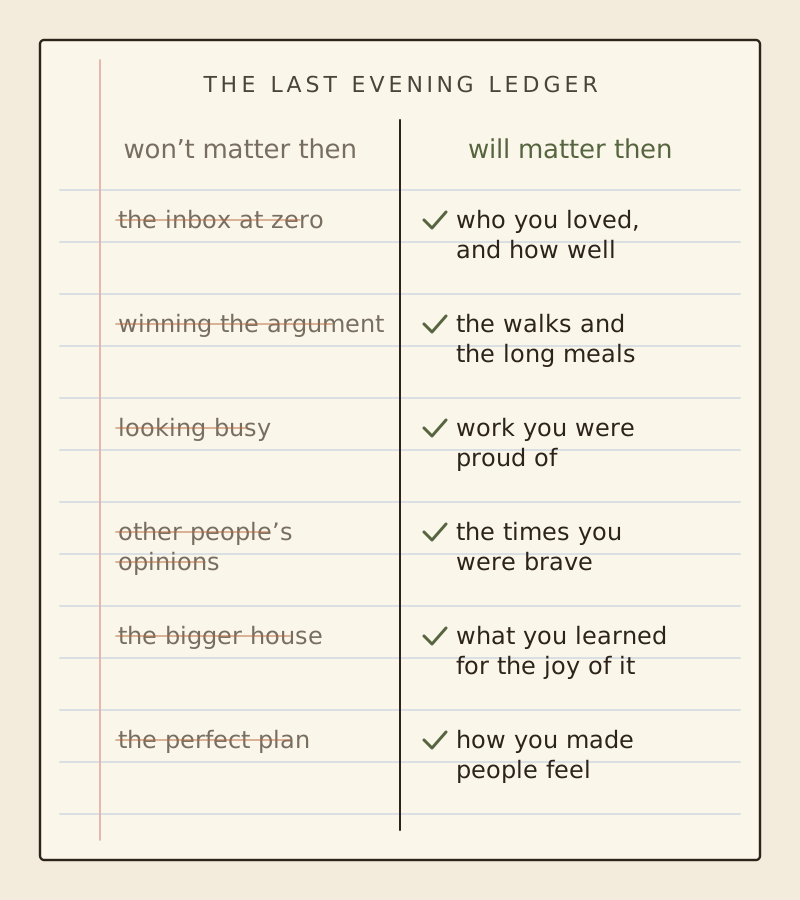
David Brooks, the writer, makes a useful distinction between résumé virtues — the skills and achievements that get you hired — and eulogy virtues: the things people say about you at the end. Were you kind, honest, brave, loving, fun to be with? We spend most of our energy on the first list and hope the second takes care of itself. It doesn’t. It needs tending, like a garden.
A handful of things seem to hold up, across every study and every tradition:
- People. A few deep relationships, tended weekly. Not occasionally, when there’s time; on purpose, the way you’d tend your body. Waldinger calls it social fitness.
- The body. Walks, real food, sleep, the ladder of small movements. Not for looks: so you can keep showing up for the people and the things you love.
- Work worth doing. Something you make with care, whether it’s code, a meal, a garden or a well-run household. Craft is one of the oldest forms of joy.
- Curiosity. Learning things for the pure pleasure of understanding them. It keeps a mind young.
- Kindness. Small, specific, daily. People will forget most of what you said. They tend to remember how you made them feel.
- Wonder. Time outside. The sky. The sea. Something much bigger than you, which puts your worries back to their proper size.
Living as a curious outsider
Now the part about society — about living inside a world that is constantly telling you who to be, what to want, and how fast to run.
One answer is to become a kind of outsider. Not a rebel, not a hermit, not a contrarian who disagrees with everything on principle; we’ve seen in Be Like the Headland that this is just another crowd. Something gentler, and more useful: a person who lives in the world without being owned by its scoreboard.
Henry David Thoreau tried this in 1845, when he built a small cabin by Walden Pond and lived there for two years. He wasn’t escaping people; he walked into town often. He was running an experiment. In his own words, he went to the woods because he wished to live deliberately, to front only the essential facts of life, and see if he could not learn what it had to teach, and not, when he came to die, discover that he had not lived.
Live deliberately. That might be the whole of it.
Programmers have their own version of this outsider spirit, and it maps onto a life surprisingly well. Eric Raymond, writing about what he called the hacker attitude, listed a few beliefs that good hackers share. Translated from code to life, they make a fine creed:
- The world is full of fascinating problems waiting to be solved. Stay curious. Treat your own life as an interesting system to understand, not a test to pass.
- No problem should ever have to be solved twice. Write down what you learn. Share it. Teach your children the things you had to discover the hard way.
- Boredom and drudgery are evil. Automate, simplify or drop the tedious parts, so your attention is free for what matters.
- Freedom is good. Notice who benefits from what you’re being told to want. Keep your mind your own.
- Attitude is no substitute for competence. Being an outsider isn’t a pose. It’s earned by actually getting good at things, patiently.
And one more from Feynman, which may be the most important of all: the first principle is that you must not fool yourself — and you are the easiest person to fool. The outsider’s real freedom isn’t from other people’s opinions. It’s from their own comfortable stories.
In practice, living this way looks surprisingly ordinary:
- Read the rules like code. Most of society’s rules are worth keeping; they encode hard-won wisdom about getting along. Some are just habits that nobody has questioned. Understand why a rule exists before you follow it, or before you quietly patch it for yourself.
- Choose your own scoreboard. Decide what you are measuring — time with your family, quality of your work, depth of your friendships — and stop checking everyone else’s.
- Opt out of races you didn’t enter. The bigger house, the newer car, the busier calendar. You’re allowed not to compete.
- Stay kind to the insiders. The outsider who sneers has just found a smaller crowd. The aim is freedom, not superiority.
The last evening, practised early
Here’s a small set of practices to bring that evening forward, so it can steer the days in between.
Each evening: before sleep, ask one question. Would I be glad, at the end, of how I spent today? Not every day will be a yes. That’s fine. The question alone changes tomorrow.
Each week: on Sunday, at the kitchen table, run a little review: one moment you savoured, one person you tended, one thing you let go of. And one thing you’ll do differently next week.
Each season: write a short letter to someone you love, saying the things you’d otherwise save for a funeral. This is Bronnie Ware’s third regret, solved with a pen.
Once a year: write your own eulogy. Just a paragraph, in plain words, the one you’d hope someone could honestly say. Then read last year’s. The gap between them is your plan.
And always: keep a small notebook of good things. Three a day is plenty. The tea, the light, the laugh. In ten years, it will be the most precious book you own.
Picture the bench again, at the end of the garden, the light going gold. There’s a cup of tea beside you, and another one for whoever is sitting with you. Down in the valley, a few windows are lit.
You’re not thinking about the inbox, or the argument you won, or how busy you looked. You’re thinking about a walk on a cold morning with someone you love. A meal that went on too long because no one wanted to leave the table. The thing you built with your own hands. The day you were brave. The thousands of small, ordinary moments you actually noticed.
Ivan Ilyich’s question arrives here too, as it arrives for everyone. What if my whole life has been wrong?
And this time you can smile, and answer it honestly.
No. It was well worth it.
Sources
- Leo Tolstoy, The Death of Ivan Ilyich (1886), chapter 11
- Bronnie Ware’s five regrets, as reported by The Next Web (2011); later expanded in her book The Top Five Regrets of the Dying (2011)
- Harvard Gazette, Work out daily? OK, but how socially fit are you? (2023), on the Harvard Study of Adult Development; Robert Waldinger and Marc Schulz, The Good Life (2023)
- Jordi Quoidbach and Elizabeth Dunn, on combating hedonic adaptation
- Ichi-go ichi-e, Wikipedia
- Richard Feynman, “What Do You Care What Other People Think?” (1988) and Cargo Cult Science (1974)
- David Brooks, The Road to Character (2015), on résumé and eulogy virtues
- Henry David Thoreau, Walden; or, Life in the Woods (1854)
- Eric S. Raymond, How To Become A Hacker
- Oliver Burkeman, Four Thousand Weeks (2021); Epictetus, Enchiridion