Craft 8 min read
The Art of Mending
On fixing things instead of replacing them — toasters, trousers, tea bowls, bodies and the people we love — and why a mended thing becomes more truly ours
Listen · 8 min
Download for later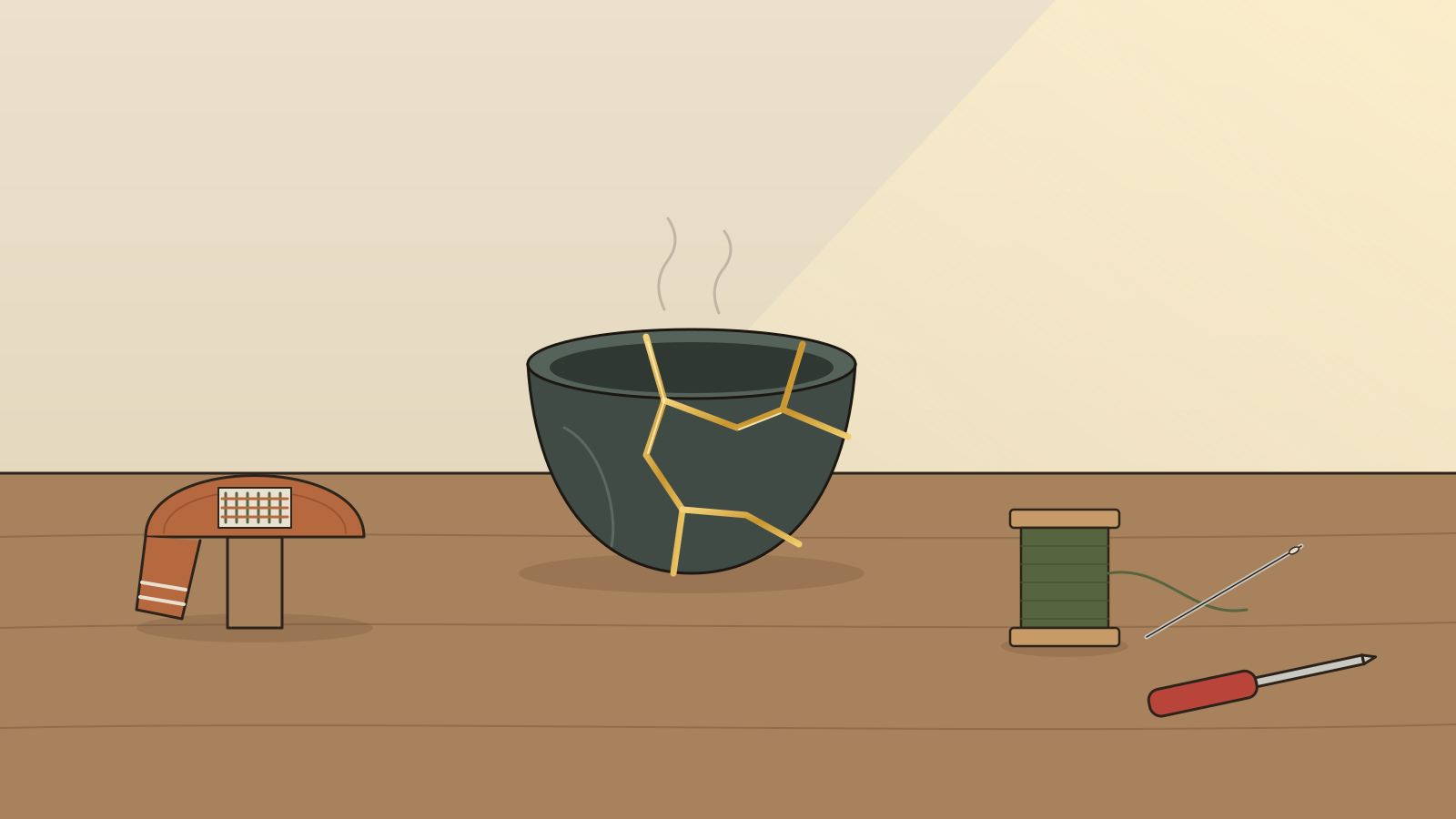
On 18 October 2009, in a small theatre in the west of Amsterdam, a journalist named Martine Postma tried an experiment. She set out tables, borrowed some tools, made coffee, and invited people from the neighbourhood to bring along anything broken. Volunteers who knew how to fix things would sit with them and repair it together.
The idea was that people would bring the kinds of things every household has: lamps that won’t light, trousers with split seams, toasters, radios, a wobbly chair. Most of them can be fixed in an afternoon. And the person who owns them goes home having learned how.
She called it a Repair Café. The idea spread from neighbour to neighbour, town to town, and by October 2025 there were more than 3,800 of them around the world, very likely including one not far from you: in a church hall, a library, a community centre, once a month, with tea.
It seems like such a small thing. Fixing a toaster. But sit with it for a while and it turns out to be one of the most quietly radical ideas in this journal.
How we forgot
For most of history, mending was simply what people did. Clothes were darned until they were more darn than cloth. Tools were sharpened and re-handled. A chair might be repaired by three generations. Every household had a needle, a hammer, a pot of glue, and someone who knew how to use them.
Then, in a single lifetime, things became cheap enough to replace, and harder to open. Cases began to be glued instead of screwed. Screws grew strange heads that ordinary screwdrivers don’t fit. Spare parts disappeared. Manuals stopped coming in the box. Quite quickly, a whole culture of knowing-how faded, and broken came to mean bin.
In 2010 the repair community iFixit published a short manifesto with a line that’s hard to forget: if you can’t fix it, you don’t own it. If you can’t open a thing, understand it and repair it, then in some real sense it owns you: you’re renting it until it decides to stop.
Things are slowly changing. Since July 2021, UK law has required makers of washing machines, dishwashers, fridges and televisions to keep spare parts available for seven to ten years, depending on the part, and to make many of them available to ordinary people and independent repairers, not just the manufacturer. Phones and laptops weren’t included. But the direction is right, and it was won by people who simply kept insisting that things should be fixable.
What a repair gives you
The obvious gifts of mending are money saved and rubbish avoided, and both are real. But the quieter gifts are the ones that change a life.
Understanding. Matthew Crawford, a philosopher who left a think-tank job in Washington to open a motorcycle repair shop in Virginia, wrote a book called Shop Class as Soulcraft about what he found there. Fixing a machine, he argued, is serious thinking. You have to form a theory of what’s wrong, test it against reality, and accept that the machine doesn’t care about your theory. It’s humbling, and it’s deeply satisfying. Every repaired thing teaches you a little about how the world actually works.
Ownership. Psychologists have a name for something you’ve probably felt: the IKEA effect. In a 2012 study, people who assembled flat-pack furniture, folded origami or built Lego sets valued their own creations far more than identical ones they hadn’t made, sometimes as much as an expert’s work. But the effect only appeared when they finished. Half-built things didn’t count. A repair works the same way. The coat you’ve mended isn’t just a coat any more. It’s the coat you saved. You’ll keep it longer, and you’ll love it more.
Freedom. Every repair you can do yourself is one less dependency on a shop, a delivery, a new purchase. It’s Unhooked, done with a screwdriver.
A mended thing becomes more truly yours than the day you bought it.
Wearing the repair openly
There are two ways to mend something. You can hide the repair, so the thing looks as if it never broke. Or you can let it show.
In Japan there’s a centuries-old art called kintsugi, “golden joinery.” A broken tea bowl is pieced back together with lacquer dusted with powdered gold, so the cracks become shining lines running through it. One well-loved story says it began in the fifteenth century, when a shogun sent a cracked Chinese tea bowl back to China for repair and it came home held together with ugly metal staples, prompting Japanese craftsmen to find a more beautiful way. Whether or not the story is true, the idea took root: the break is part of the bowl’s history, and there’s no shame in it. A kintsugi bowl is often more treasured than an unbroken one.
Japan also has sashiko, which means something like “little stabs”: simple running stitches, traditionally white thread on indigo cloth, used by country families in the Edo period to strengthen and patch worn clothes. Over generations, some garments were patched so many times that the original fabric almost disappeared beneath the mending. Those patched textiles are called boro, and today they hang in museums.
Visible mending is a small act of honesty. It says: this thing has been used, and loved, and broken, and cared for. It has a story. It’s still here.
The ship that was always being rebuilt
The Greek writer Plutarch tells of the ship on which the hero Theseus sailed home from Crete. The Athenians kept it for centuries, and whenever a plank rotted, they replaced it with new timber. Eventually philosophers began to argue: if every plank has been replaced, is it still the same ship?
It’s a famous puzzle, and there’s no tidy answer. But a mender might offer a gentle one. A thing is not just its materials. It’s its shape, its use, and the care that has gone into keeping it going. A grandmother’s patched quilt is more hers, not less, for every patch she sewed.
Perhaps that’s true of us, too. We’re all, in a sense, being constantly rebuilt: by sleep, by food, by the slow repairs of the body after every effort. That’s how A Ladder of Small Movements works: you put a little strain on the body, it mends itself, and it comes back a little stronger. Growth, in bodies, is mostly repair.
Mending people
The most important things we ever mend aren’t objects.
The developmental psychologist Edward Tronick spent decades filming parents and babies together. One of his most striking findings is how imperfect even loving relationships are. In his research, as many as 70% of everyday interactions between babies and their caregivers involved some kind of mismatch: a signal missed, a smile not returned, a cry misread. That’s normal. What mattered for the child, Tronick found, wasn’t avoiding these small ruptures. It was the repair: noticing the mismatch, and coming back together. Children learn, over thousands of small repairs, that connection can break and be restored. That lesson is the foundation of resilience.
The same is true between adults. Strong friendships and marriages aren’t the ones that never crack. They’re the ones that have been mended, many times, with care — kintsugi relationships, stronger at the seams.
A human repair kit is surprisingly simple:
- Notice the break. Don’t pretend it didn’t happen.
- Name it, and your part in it. “I was short with you this morning. That wasn’t fair.”
- Make it right, if you can.
- Change something, so it’s less likely to happen again.
It’s the same as fixing a lamp: find the fault, own it, fix it, and make it a little sturdier than before.
A small mending life
You don’t need a workshop. You need a drawer, some patience, and permission to be bad at it for a while.
A mending kit fits in a shoebox:
- needles, strong thread in a few colours, a darning mushroom (or an old lightbulb), a few patches;
- a small set of screwdrivers with interchangeable bits, including the odd-shaped ones;
- wood glue, a two-part epoxy, a tube of superglue;
- sandpaper, a little oil, some tape;
- a notebook for what you fixed and how.
A practice:
- Fix one thing a month. A button, a wobbly table leg, a dripping tap, a sock. Start small.
- Look it up first. Repair guides and videos exist for almost everything; the community at iFixit has written thousands of free step-by-step guides.
- Go to a Repair Café. Take something broken and sit with a volunteer. You’ll get the thing fixed and, more importantly, learn how.
- Buy things that can be mended. Screws rather than glue, parts you can get, makers who publish manuals. Fewer things, better made, kept longer.
- Teach a child. Let them hold the screwdriver. A child who has fixed something grows up believing the world can be fixed.
- Mend visibly, now and then. Patch the knee of your jeans with a contrasting thread. Let the repair show. Notice how it feels.
Picture a kitchen table, years from now. On it sits an old tea bowl with a thin gold line running through it, where it broke once and was carefully mended. A darned jumper hangs on the back of a chair. A table that wobbled for a while now stands perfectly straight, because someone took the time.
None of it is new. All of it is loved. And the people sitting around the table have been through a few breaks of their own, and mended those too.
That’s what mending teaches, in the end. Nothing worth keeping stays unbroken. The art is in what you do next.
Sources
- Repair Café, Wikipedia — founding in Amsterdam and the number of Repair Cafés worldwide
- iFixit, The Self-Repair Manifesto (2010)
- Computing, Consumer-friendly ‘right to repair’ law comes into effect in the UK (2021)
- Matthew Crawford, Shop Class as Soulcraft (2009); profile in The University of Chicago Magazine
- Michael Norton, Daniel Mochon and Dan Ariely, The IKEA effect: When labor leads to love, Journal of Consumer Psychology (2012), abstract
- Kintsugi, Wikipedia
- Open Culture, The Japanese traditions of sashiko and boro
- Plutarch, Life of Theseus; Ship of Theseus, Wikipedia
- On Edward Tronick’s research into rupture and repair: Thoughtful Parent; Edward Tronick and Claudia Gold, The Power of Discord (2020)