Low-tech 5 min read
The Phone at the End of the Lane
On letting tools into the house one at a time, and asking each one what it is for
Listen · 5 min
Download for later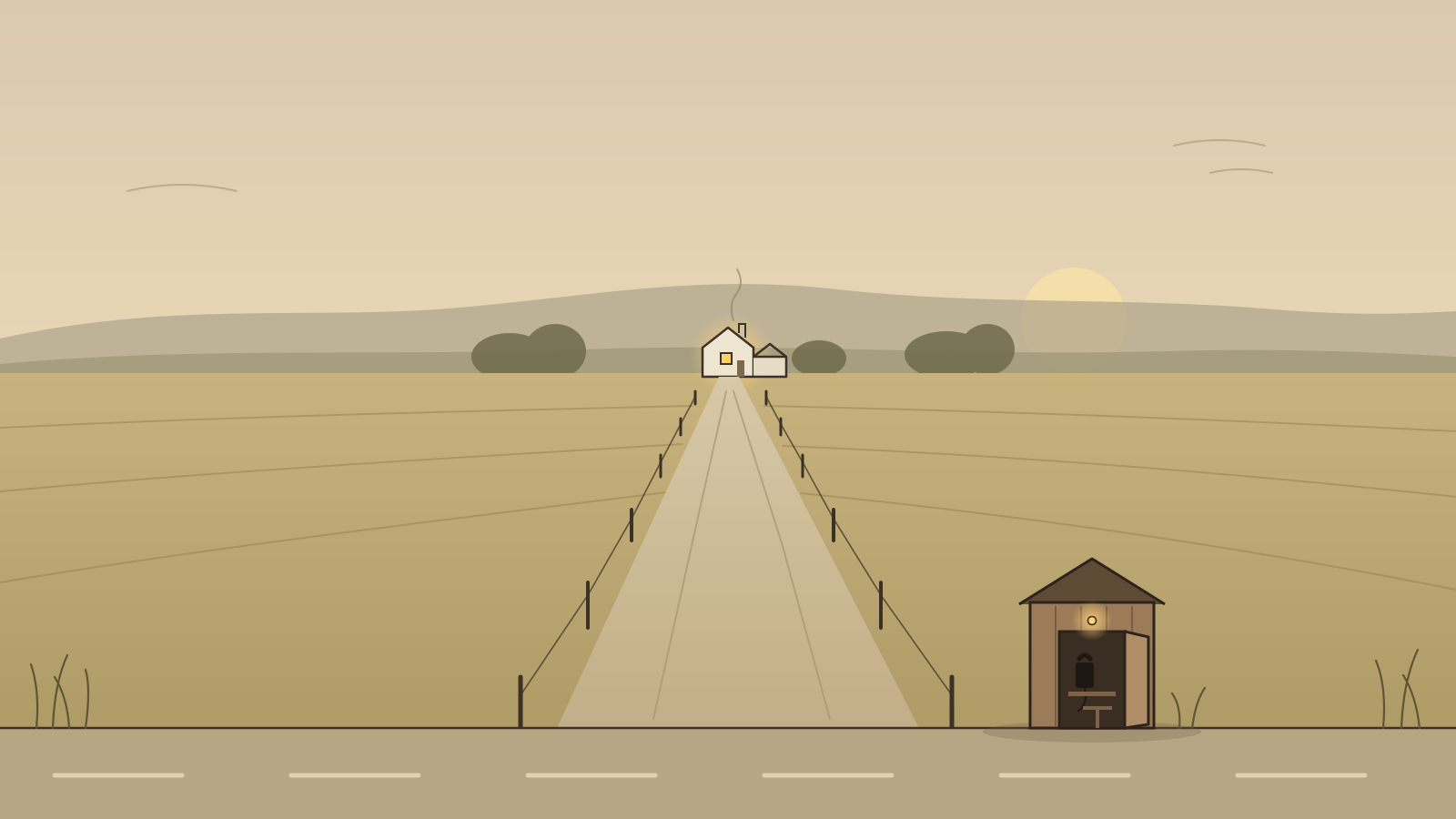
Picture a farm lane in Lancaster County at the end of a long day. Gravel, two lines of fence posts, a field going gold. And at the very bottom, where the lane meets the road, a wooden box about the size of a garden shed. Inside it there is a stool, a shelf, and a telephone.
The phone works perfectly well. Families use it to call the vet, to order feed, to hear that a grandchild has arrived. What they don’t do is carry it into the kitchen. For more than a century, many Old Order Amish communities have kept the telephone out of the house and put it here instead: close enough to be useful, far enough that using it means putting on your boots.
It is easy to read that shed as a refusal. It is something more interesting. It is a decision about distance.
Not against, but slower
When the writer Kevin Kelly spent time among Amish families, he came away describing them less as technophobes and more as careful tinkerers. They modify engines, rig up pneumatic tools, and argue about new devices with real seriousness. The difference, as he told it, is that they adopt slowly and selectively, saying no far more often than yes, and they judge a thing by watching what it actually does to people rather than what it promises.
The test they apply is simple to state and hard to live by: does this make our families and our community stronger, or weaker?
The telephone failed that test in the house, and passed it at the end of the lane. Inside, it was a door left open to the world at every hour. It made idle talk effortless and visiting unnecessary. It pulled attention away from the table. Out by the road, the same machine became something else: a tool you walked to on purpose, used for a reason, and walked away from.
The question is never only should we have this? It is also where does it live?
Tools that serve, and tools that rule
Half a century ago, the philosopher Ivan Illich drew a line through all of our tools. Some, he said, are convivial: they widen what a person can do on their own terms. A bicycle, a hand saw, a library card. Others grow past their purpose until the arrangement flips, and the person ends up serving the tool. Illich thought every powerful technology passes two thresholds. First it brings real, astonishing benefit. Later, if no one is paying attention, that same benefit becomes the justification for depending on it completely.
The Amish phone shed is what it looks like to stop a tool between those two thresholds. Keep the benefit. Refuse the dependence. Not with willpower, which is always tired by evening, but with architecture: a few dozen yards of gravel that do the remembering for you.
The lane in a modern house
None of this requires a farm, a church district, or a horse. It only requires noticing that every tool in a home already has an address, whether we chose it or not. The phone lives on the pillow. The television lives at the centre of the room the chairs are pointed at. The laptop lives at the dinner table, or near enough.
So the question for a quiet life is not “how do I use less technology?” It is gentler and more practical: for each tool, where is the end of my lane?
Some places people have found it:
- A charging shelf by the front door. Phones sleep there, not in bedrooms. Alarm clocks are cheap.
- One device, one job. A tablet that only holds books. An old laptop that only writes. A tool that can do everything tends to be used for the worst thing it can do.
- Inconvenience on purpose. Log out of the feed after every visit. Keep the console in a cupboard. A thirty-second barrier is the modern equivalent of putting on your boots.
- The trial period. Before something new enters the house, give it a month on probation, and then ask the Amish question honestly: are we closer, or further apart?
An evening audit
If you want to try this, it fits in a single evening. Walk through the house with a notebook. For every screen, speaker and charger, write down three things:
- What did I bring this in to do?
- What does it actually do, most days?
- If it lived further away, what would I lose, and what would I get back?
You may find, as many people do, that most things can stay exactly where they are. A few will want moving. And perhaps one will want a little wooden shed of its own, somewhere at the bottom of the lane, where you can still reach it whenever you truly need to.
The people who built those sheds were not trying to stop the world. As one of them put it to Kelly, the aim was only to slow it down enough to choose. That is a freedom available to anyone, one tool at a time.
Sources
- Kevin Kelly, “Amish Hackers” (2009), summarised in Mental Floss
- Erik Wesner, Do Amish use telephones?, Amish America
- Phone shacks: a closer look, Amish America
- Ivan Illich, Tools for Conviviality (1973), overview on Wikipedia