Minimalism 10 min read
Unhooked
Getting free of debt, of attention traps, of clutter and of the quiet chains in your own body and mind — one small link at a time
Listen · 10 min
Download for later
The novelist Kurt Vonnegut liked to tell a story about his friend Joseph Heller, the author of Catch-22. The two of them were at a party given by a billionaire on Shelter Island, off the coast of New York. Vonnegut leaned over and pointed out that their host had probably made more money in a single day than Catch-22 had earned in its entire history.
Heller replied that he had something the man could never have. Vonnegut asked what that could possibly be.
The knowledge that I’ve got enough.
Vonnegut thought it was the wisest thing he’d ever heard, and later turned it into a short poem. It’s worth carrying with you, because it points straight at what freedom actually is. Not having everything. Wanting little enough, and owing little enough, that your life is your own.
Seneca put it the same way two thousand years earlier, in one of his letters: it is not the man who has too little, but the man who craves more, that is poor.
Small chains
Very few people are held by one great chain. Most of us are held by dozens of small ones, each light enough to ignore:
- a credit card balance that never quite reaches zero,
- a phone that buzzes a hundred times a day,
- a handful of subscriptions we’ve half forgotten,
- a loft full of things we’re keeping “just in case”,
- a calendar without a single empty evening,
- a habit we’d quite like to stop,
- a dozen unfinished tasks circling in the back of the mind.
None of these feels like a chain. That’s what makes them work. But each one quietly decides something for you. The debt decides which job you can afford to leave. The phone decides where your attention goes. The clutter decides how your Saturday is spent. The calendar decides your evenings before you get to them.
If you’ve read The Fewest Doors, you’ll recognise the shape. In software, every dependency is a stranger you’ve given some power over your system. A life works the same way. Every subscription, balance, app and obligation is a dependency with a little power over you. Freedom is the same discipline as good engineering: fewer dependencies, each one chosen on purpose.
Let’s take them off, one at a time.
The money chain: debt
Debt is the heaviest of the small chains, because it doesn’t stay the same size. Interest makes it grow while you sleep. It turns your future self into someone else’s employee.
The hardest thing about high-interest debt is how much it costs to go slowly. Here’s an illustration. Take a £3,000 credit card balance at an interest rate of 30% a year, which is, if anything, gentle: in 2026 the average advertised rate on UK credit cards was nearer 37%. Now see what happens with different monthly payments:
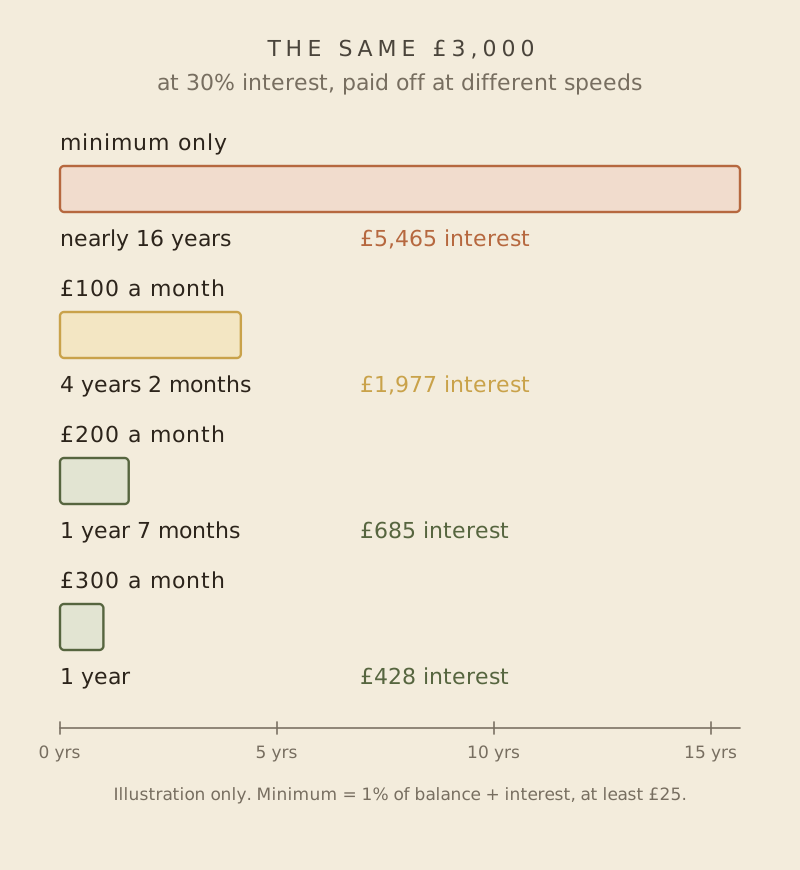
Look at the top bar for a moment. Paying only a typical minimum, the same £3,000 takes nearly sixteen years to clear and costs nearly twice the original balance in interest. Doubling a modest payment from £100 to £200 cuts more than two years off and saves around £1,300.
That’s the chain. Here’s how people take it off:
- Write everything down. Every balance, its interest rate, its minimum payment. One page. Most people find this the hardest step, and the most relieving. A chain you can see is already lighter.
- Stop the chain getting longer. Remove saved cards from shopping sites and browsers. Delete shopping apps. Put a day of friction between wanting and buying. You can’t empty a bath with the tap running.
- Build a small cushion. Even a few hundred pounds set aside means the next broken boiler doesn’t become new debt.
- Choose an order, and stick to it. There are two well-known ways. The avalanche pays the minimum on everything and puts every spare pound on the debt with the highest interest rate: mathematically the cheapest. The snowball clears the smallest balance first, then the next: not the cheapest, but each closed account is a small victory. Researchers at Northwestern University studied about 6,000 people paying off card debt and found that those who cleared small balances first were more likely to clear all of it. Motivation is real. Choose the method you’ll actually keep doing.
- Ask for help early. It’s free. In the UK, organisations such as StepChange, National Debtline and Citizens Advice give free, confidential debt advice, and can help negotiate with lenders. You never need to pay a company for debt advice.
And then, the quieter half of the work: decide what enough looks like. When income rises, spending has a way of rising to meet it, and the chain simply gets longer and more comfortable. A number written down — this is what our life costs, and this is enough — is a remarkable defence. Every pound above it can buy time, which is the only thing money is truly for.
A note: this is general information, not financial advice. If debt is weighing on you, the free advice services above are the right first call.
The attention chain
We’ve spent time on this in Be Like the Headland and The Phone at the End of the Lane, so here is just the practical kit.
The phone isn’t the problem; the phone’s defaults are. They were set by companies paid in your attention. Change them:
- Notifications only from people. Not apps, not news, not shops. If a human didn’t write it to you, it can wait until you go looking.
- A home screen of tools, not slot machines. Maps, camera, messages, music. Move everything else off the first screen, or off the phone.
- A place for the phone to sleep that isn’t your bedroom. An old-fashioned alarm clock costs a few pounds.
- Try a reset. The writer Cal Newport suggests a thirty-day digital declutter: step away from every optional technology for a month, fill the time with things you value, then bring back only what genuinely serves something you care about, with a rule for when and how you use it. Most people bring back far less than they expected.
The goal isn’t to hate technology. It’s to make it a tool again: something you pick up, use and put down.
The silent chains: subscriptions
Small automatic payments are the most invisible chain of all. Each one is reasonable. Together they’re a second rent.
Once a quarter, sit down with your bank statement and a pen. Circle every payment that repeats. For each, ask: did I use this in the last month, and would I sign up for it today? Cancel everything that’s a no. Rotate the rest: one streaming service at a time, not four.
The heavy chains: things
The Gentle Kindness of Death Cleaning covers this in full, so just a reminder: every object charges a little rent in attention, space and care. A loft of “just in case” is a quiet monthly bill. Keep what you use and love. Let the rest go to someone who will.
The time chain: commitments
A calendar with no gaps is a life with no room. Most of us say yes too easily, because no feels unkind in the moment, and the cost of yes arrives later.
- Keep the priority table from The Computer That Knew What to Drop where you can see it. If a request doesn’t serve something on it, it’s a no.
- Learn one gentle sentence: thank you for thinking of me, but I can’t take that on. No long explanations.
- Protect empty space as fiercely as any meeting. Write nothing into your diary, on purpose, one evening a week.
The body’s chains
Freedom has a physical side too. A body can be held by habits that started as pleasures and slowly became needs: the third coffee, the late-night scrolling, the drink that turned into every evening, the sugar at four o’clock, the hours in a chair.
You don’t need to fight them all at once. Pick one. Replace rather than remove: a walk where the scroll used to be, a glass of water before the coffee, a book in bed instead of the phone. Small swaps compound, exactly like interest, but in your favour.
And notice the other kind of freedom the body gives: being able to walk for hours, carry your shopping up a hill, sit on the floor with a child and get back up, sleep through the night. A Ladder of Small Movements is, in the end, a ladder towards that freedom.
The mind’s chains
The last chains are the ones nobody else can see.
The productivity writer David Allen noticed that most of us carry dozens of open loops: things we’ve committed to doing, or meant to do, held only in our heads. Each one tugs at us, at random moments, all day. His remedy is beautifully simple: your mind is for having ideas, not holding them. Write every loop down, somewhere you trust, and decide its next step. A notebook will do.
Then there are worries about things that aren’t ours to control. Epictetus would ask you to sort them: up to me, or not up to me? Act on the first kind. Let the weather be the weather.
And then there are grudges, which, as we saw in The Last Evening, are heavy things we keep carrying long after they stop being useful. Putting one down isn’t saying it didn’t matter. It’s choosing not to let it decide any more of your days.
Twelve weeks to unhook
You don’t need to do all of this at once. Here’s a gentle order, one small thing a week:
- Week 1: write down every debt, balance and interest rate on one page.
- Week 2: remove saved cards from shops and browsers; delete shopping apps.
- Week 3: circle every recurring payment on your statement; cancel the ones you wouldn’t sign up for today.
- Week 4: choose avalanche or snowball, and set up the payments. Call a free advice service if it feels too heavy.
- Week 5: turn off every notification that isn’t from a person.
- Week 6: give the phone a bed outside the bedroom; buy an alarm clock.
- Week 7: clear one cupboard, death-cleaning style.
- Week 8: write nothing into one evening of your diary, every week from now on.
- Week 9: pick one body habit and swap it for something kinder.
- Week 10: empty your head onto paper: every open loop, with a next step.
- Week 11: write down your enough: what a good month actually costs.
- Week 12: look back. Which chain was heaviest? Which was easiest to lift? Choose the next one.
The chains don’t all come off at once, and some take years. That’s fine. Every link you remove gives something back: money gives back time, attention gives back your days, space gives back your weekends, a quiet mind gives back sleep. And slowly, almost without noticing, you become the person in Heller’s story: someone the richest man at the party can’t quite understand, because they have something he can’t buy.
Enough.
Sources
- Kurt Vonnegut, “Joe Heller”, The New Yorker (2005), via The Marginalian
- Seneca, Moral Letters to Lucilius, Letter 2 (trans. Richard Gummere, 1917)
- Finder UK, What is the average credit card APR in the UK? (May 2026); repayment figures are my own calculation
- Kellogg School of Management, The snowball approach to debt (Gal and McShane, 2012)
- GOV.UK, Get free debt advice
- Cal Newport, Digital Minimalism (2019), summarised at Sloww
- David Allen, interviewed in IEEE Spectrum